THE PILLAR 3A TAX TRAP FOR LEGATION CARD HOLDERS (CD / IO)


During the peak July onboarding cycle, newly arrived international officials and diplomats are routinely targeted by local financial brokers pushing Swiss pension products—specifically, the Pillar 3a (Prevoyance liée). While the Pillar 3a is a highly effective tax-deduction vehicle for standard Swiss tax residents, it represents a structural financial trap for individuals operating under a Federal Department of Foreign Affairs (FDFA) institutional status.
We are going to analyzes the regulatory friction between diplomatic tax exemptions and the Swiss third-pillar architecture, illustrating why allocating capital to a Pillar 3a results in a guaranteed net financial loss for international card holders.
1. The Mechanism of the Trap: Zero Tax Relief on Entry
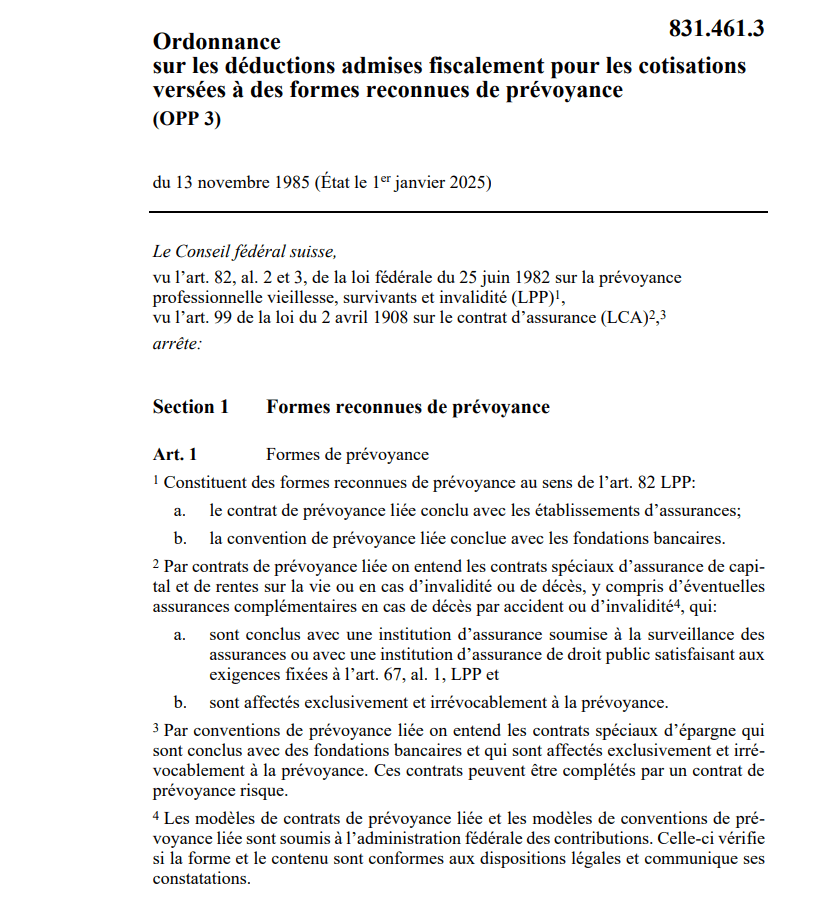
The fundamental value proposition of a Swiss Pillar 3a relies entirely on Article 82 of the Federal Act on Occupational Old-age, Survivors' and Invalidity Insurance (LPP). This statute allows ordinary taxpayers to deduct their annual contributions directly from their gross taxable income, yielding an immediate tax saving based on their marginal tax bracket.
For primary holders of a Carte de légitimation (Types B, C, D, etc.) or officials protected by an institutional Headquarters Agreement (Accord de siège), this tax incentive is entirely caduque:
Under federal law, your institutional salary is already 100% exempt from Swiss income taxes.
Because your baseline taxable income in Switzerland is officially zero, you have no taxable mass to deduct the Pillar 3a contributions against.
You are effectively investing "clean," already-exempt capital into a restrictive system without receiving a single franc of the front-end tax relief the product was designed to provide.
2. The Exit Penalty: Taxation on Capital Withdrawal
The structural risk deepens when an official terminates their mandate, is reassigned to an overseas duty station, or reaches retirement. Under Swiss fiscal rules, withdrawing capital from a Pillar 3a account is a taxable event.
The Accounting Penalty:
When you liquidate a Pillar 3a account—whether leaving Switzerland permanently under Article 5 of the regular ordinance or upon retirement—the Swiss Federal Tax Administration (SFTA) and the cantonal authorities levy a mandatory Capital Withdrawal Tax (Impôt sur le retrait de capital).
ARBITRAGE ANALYSIS: THE PILLAR 3A TRAP
1. At Entry (Capital Contribution)
Standard Swiss Resident: Benefits from an immediate tax deduction of 20% to 40% on annual contributions.
Diplomatic Card Holder (CD / IO): 0% tax benefit. Because your official institutional income is already exempt under a headquarters agreement, this tax deduction is completely void.
2. During Growth (Capital Accumulation)
Standard Swiss Resident: Tax-free compounding of all investment returns and dividends.
Diplomatic Card Holder (CD / IO): Identical tax-free growth, but without the critical front-end tax leverage to boost your principal.
3. At Exit (Capital Withdrawal)
Standard Swiss Resident: Lump-sum withdrawal is taxed at a heavily reduced, segregated rate separate from regular income.
Diplomatic Card Holder (CD / IO): Subject to full Capital Withdrawal Tax. You are forced to pay an exit tax to the Swiss state on funds that were already "clean" and tax-exempt when you first contributed them.
THE NET REALTY
For a diplomat, a Pillar 3a operates as a mechanism of reverse tax optimization. You lock up capital that is already net of tax inside a rigid system, only to pay a penalty tax to the Swiss authorities upon your departure or retirement. The net outcome of this strategy is a pure erosion of your hard-earned capital.
3. Statutory Illiquidity and Broker Overcharging
Beyond the structural tax deficit, Pillar 3a products sold by insurance companies (Polices d'assurance 3a) introduce severe contractual lock-ins. These long-term financial commitments conflict directly with the inherent volatility and unpredictable rotation cycles of international diplomatic mandates.
In the event of a sudden reallocation or overseas transfer during the initial years, early termination of the insurance policy triggers harsh surrender value (valeur de rachat) penalties, routinely resulting in an immediate loss of up to 50% of your total paid-in capital.
The Early Termination Penalty:
Many brokers convince newly arrived expats to sign long-term, insurance-linked 3a contracts, blending savings with life insurance. If your mission terminates early and you must close the account within the first 3 to 5 years, the insurance company applies a brutal Surrender Value (Valeur de rachat) penalty. It is common to lose up to 50% of your total paid-in capital upon early termination of an insurance-linked pension contract.
4. The Strategic Pivot: Deploying Pillar 3B Frameworks
To secure capital growth while preserving complete international mobility, diplomatic staff must bypass the 3a framework entirely and utilize the Pillar 3b (Prévoyance libre / Unlinked Pension).
Under Section 4 of the Geneva Cantonal Tax Law (LIPP), the Pillar 3b does not offer a federal tax deduction on the way in, which is irrelevant to an already tax-exempt diplomat. Crucially, however, it provides complete structural immunity on the way out:
0% Capital Gains Tax: Capital gains generated within a qualified Swiss 3b insurance structure are completely exempt from domestic taxes upon withdrawal.
Global Liquidity: Well-structured 3b portfolios do not enforce the rigid, statutory exit barriers of the 3a, allowing diplomats to reallocate or withdraw their capital seamlessly during a sudden diplomatic rotation.
Regardless of your length of service in Switzerland, if your household operates under a carte de légitimation and you are holding or considering a standard Swiss pension contract, do not sign any private financial agreements without a dedicated diplomatic status audit.
Mitigating the structural capital erosion caused by misallocated pension assets requires proactive regulatory alignment. Contact our bureau to audit your wealth architecture and structure a compliant, tax-insulated Pillar 3b strategy before your first deployment cycle ends.